+91 9088498142
info@voteniti.in
In an era where our scrolls and swipes dictate much of what we know, a new silent player has entered the political arena: Artificial Intelligence.
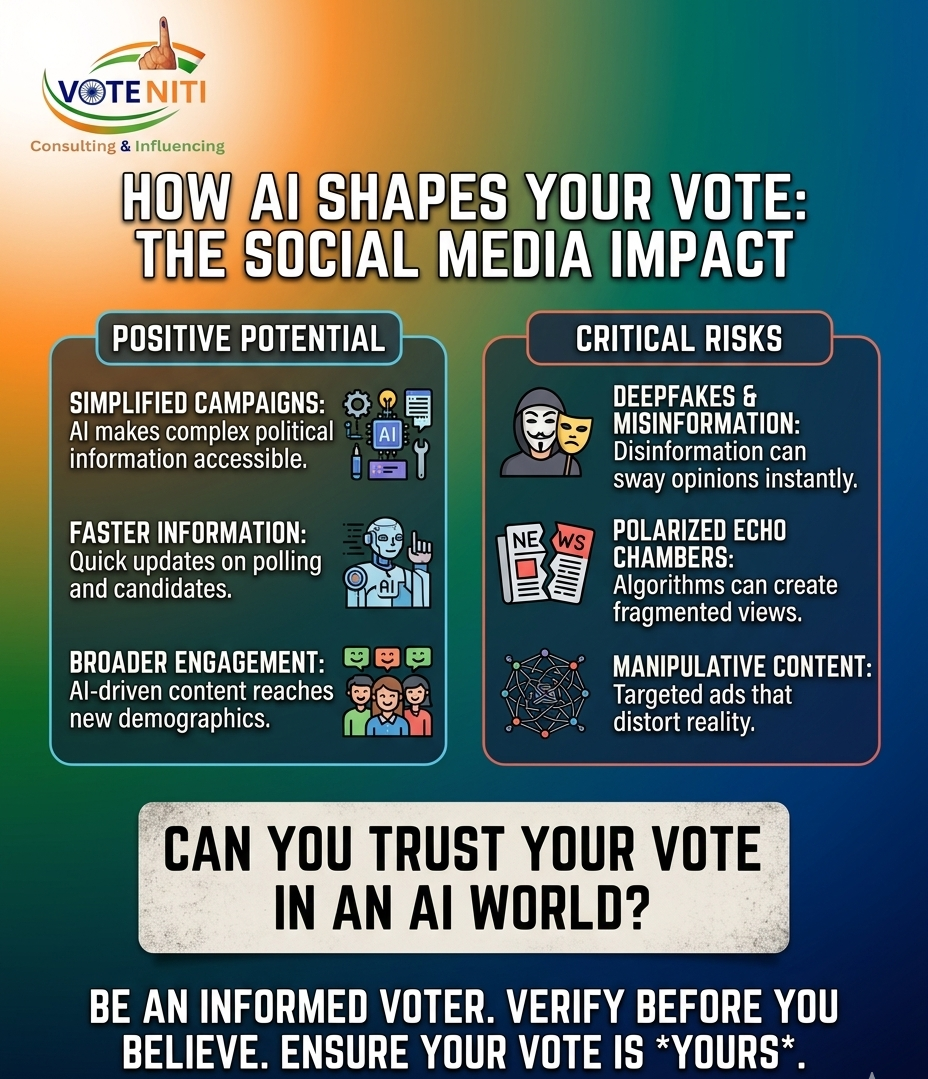
The infographic from VOTENITI raises a heavy question: "Can you trust your vote in an AI world?" As technology moves faster than policy, understanding the duality of AI’s impact on social media is no longer optional—it’s a civic duty.
AI isn't just a "boogeyman" in politics; it has the power to make the democratic process more inclusive and efficient.
Simplified Campaigns: Let’s face it—policy papers are dense. AI can distill complex legislative jargon into accessible summaries, helping voters understand what they are actually voting for.
Faster Information: In the heat of an election, timing is everything. AI-driven tools provide real-time updates on polling stations, candidate schedules, and breaking news.
Broader Engagement: By using predictive analytics and language translation, AI allows campaigns to reach previously overlooked demographics, ensuring more voices are part of the conversation.
With great power comes great potential for manipulation. The same algorithms that help us find new music can also be used to distort our reality.
Deepfakes & Misinformation: We are entering an era where seeing isn't always believing. AI-generated videos (deepfakes) can make candidates appear to say things they never said, swaying public opinion in seconds.
Polarized Echo Chambers: Social media algorithms are designed to keep you engaged, often by feeding you content that reinforces your existing biases. This creates "echo chambers" where dissenting views are silenced and society becomes increasingly fragmented.
Manipulative Content: Micro-targeted ads can be hyper-personalized to exploit specific fears or desires of a small group of voters, often using data to "nudge" behavior in ways that aren't immediately obvious.
The final takeaway from the VOTENITI message is a call to action. While AI can shape the information you see, it shouldn't dictate the choice you make.
Be an informed voter. Verify before you believe. Ensure your vote is yours.
Cross-Reference: If a video or news story seems shocking, check multiple reputable sources to see if it’s being reported elsewhere.
Check the Source: Look for verified accounts and official campaign websites.
Recognize the "Nudge": If an ad feels like it’s preying on your emotions, take a step back and look at the hard data.
AI is changing the game, but the power still rests in the hand that holds the ballot. Stay sharp, stay skeptical, and stay informed.

 April 04, 2026 - BY Admin